Look out above! It’s Maggie swooping season
If you spend time outdoors in Australia during spring, you may notice people are on the lookout from the skies. Spring is the season when the days get warmer, birds are busy nesting and everyone suddenly remembers which streets have the particularly enthusiastic Magpie.
Cyclists wearing helmets with cable tie spikes, walkers carrying sticks, people taking detours around perfectly innocent-looking trees…means it’s Swooping Season.
Why do Magpies swoop?
Australian Magpies or Maggies, as we like to call them, don't swoop because they're mean, and they're not randomly plotting against the neighbourhood.
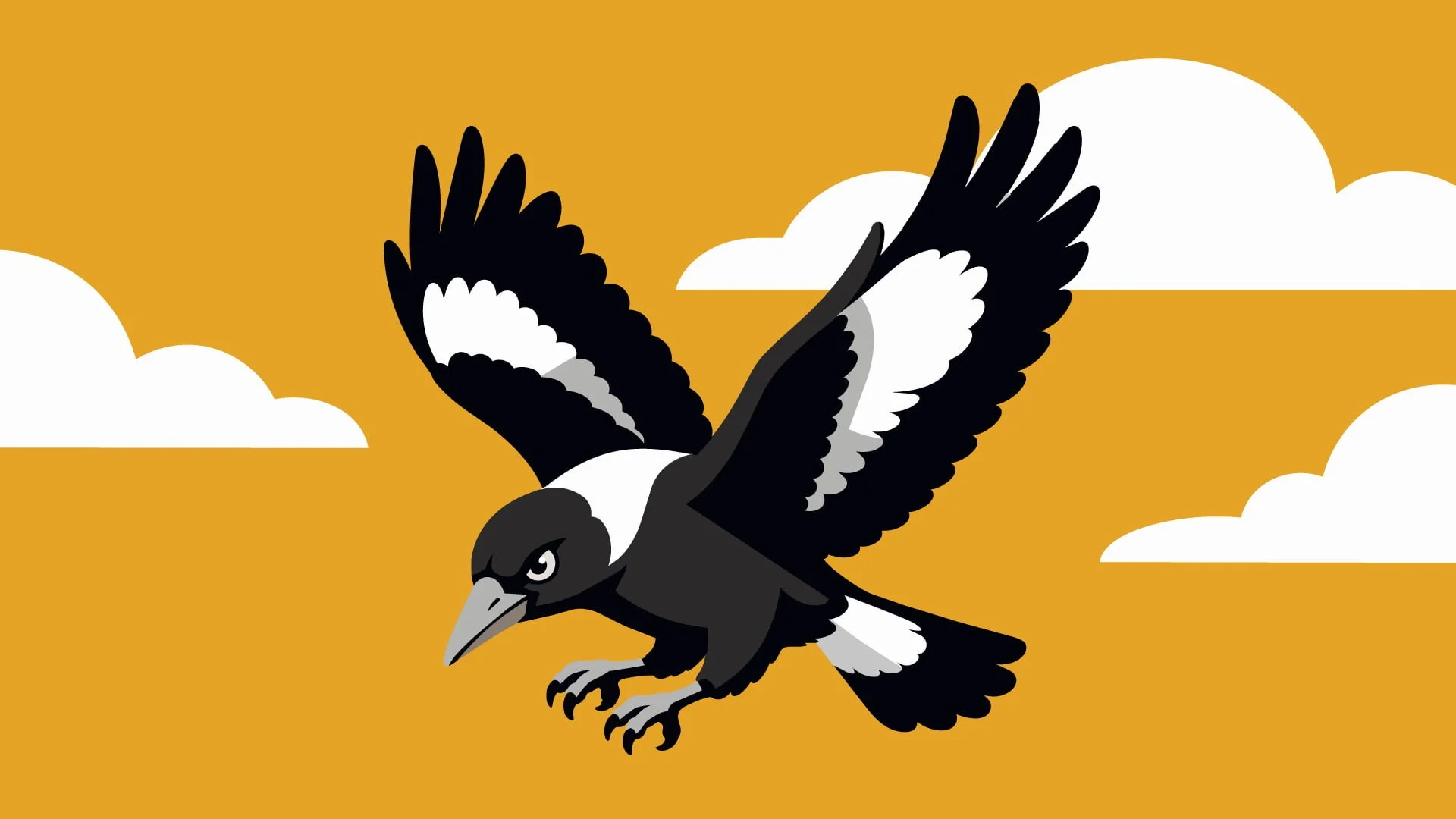
Nesting Magpies become fiercely protective of their eggs and chicks during spring. If a Magpie thinks you're getting too close to its nest, it may swoop to send you packing. And they’re are not particularly fussy about who gets the warning, walkers, runners, cyclists, and dogs, can all find themselves on the receiving end of a feathered aerial attack.
To the Magpie, you're not someone just passing, you're an intruder … and this is their patch.
A swooping Magpie can be surprisingly determined, and it may make repeated passes over whatever it perceives as a threat, particularly if you're travelling quickly through its territory.
Magpies aren't the only birds who will give a good swoop, also look out for Butcher Birds and the Plovers with their loud and distinctive ‘Ka ka ka’ when you get too close to their nests on the ground.
We love our Magpies
Despite spending several weeks each spring terrorising the locals, Magpies are much loved. Their beautiful warbling song is one of the most recognisable sounds in Australia. They're intelligent, social birds with complex family groups and fascinating behaviour.
Australians will happily tell a tale about being swooped, then put some water out for that same bird.
Your local Magpie knows who you are
That local bird you've been seeing around the neighbourhood may actually know who you are, research has shown that Magpies can remember people, so if you've been kind to your local Magpies throughout the year, they may remember you.
Will this guarantee immunity from swooping? Absolutely not. But it can't hurt to stay on their good side.
Maggies have outstanding vocal skills and they’re highly social
Magpies are known for their beautiful warbling call, but they also can imitate other noises, including the calls of other birds and even sounds such as dogs barking and horses neighing.
Magpies are also highly social and usually live in family groups that defend their territory together. Young Magpies can stay with their parents for several years, helping defend the territory and even assisting with younger siblings. So that noisy group of Magpies in the park might actually be an extended family having a morning meeting.
Male or female? How to tell the difference
You can often tell male and female Australian Magpies apart by looking at the colouring on their backs and necks. Once you know what you're looking for, it's quite fun to see if you can tell the difference.
Males: Have a bright, solid, pure-white patch on the back of the neck and upper tail and tend to be slightly larger, bulkier, and heavier, with longer or thicker bills.
Females: Have a grey or mottled, grey-and-white patterned patch on the back of the neck, and are slightly smaller and more slender.
Young birds: Both young males and females look similar with grey-mottled or brown-tinged neck feathers.
Although perhaps save your bird identification skills for when the Magpie is sitting peacefully in a tree. Trying to identify one while it's performing a high-speed fly-by is not recommended.
Five ways to avoid being swooped
Magpies are protected native wildlife, so the best approach is to give them space and respect their nesting territory.
Be kind all year round - Magpies can remember human faces and behaviour. Being a friendly neighbour may help your relationship with the local birds. It's basically the Australian version of "be nice to your neighbours."
Keep your distance - Give nests plenty of space, don't approach a nest or try to remove it. Native wildlife and their nests are protected by law, and disturbing nesting birds can make defensive behaviour worse. Let the Magpie parents get on with raising the kids.
Slow down - If you're cycling or running through an area where Magpies are nesting, slow down. Fast-moving objects are more likely to be seen as a threat.
Protect your head - Wear a hat, helmet or carry an umbrella to help protect your head and face when passing through a known swooping area.
Take another route - This is probably the easiest solution. If a particular path is known for swooping during nesting season, take another route until the breeding season is over.
For Australians, magpie swooping is simply part of spring. Give the birds some space, protect your noggin and let them get on with raising the next generation of Aussie magpies. And when you see your local magpie, give them a friendly "G'day" as you pass.
Aussie Word: Swoop
Swoop means to move quickly downwards through the air, often towards something below.
In Australia during spring, you might hear "Watch out, a maggie is swooping!"
It's one of those wonderfully Australian seasonal phrases that makes perfect sense once you've experienced it. And if you haven't experienced it yet? Just wait until spring.
Want to know more about the weird, wonderful and very Aussie things you'll encounter Down Under?
Explore G'Day Galah for more Australian words, wildlife, culture, facts and quirky traditions. Start with the free Aussie Top 20 guide and get cracking. Download the free Aussie Top 20 guide →