What time is it in Australia? It’s… complicated
If you’re planning a trip to Australia, organising a video call with an Aussie, or simply trying to understand why someone in Perth is still having breakfast while their mate in Sydney is eating lunch, you’ve come to the right place.
Australia might look like one country on the map, but when it comes to time, things get a little… creative.
Australia’s three main time zones
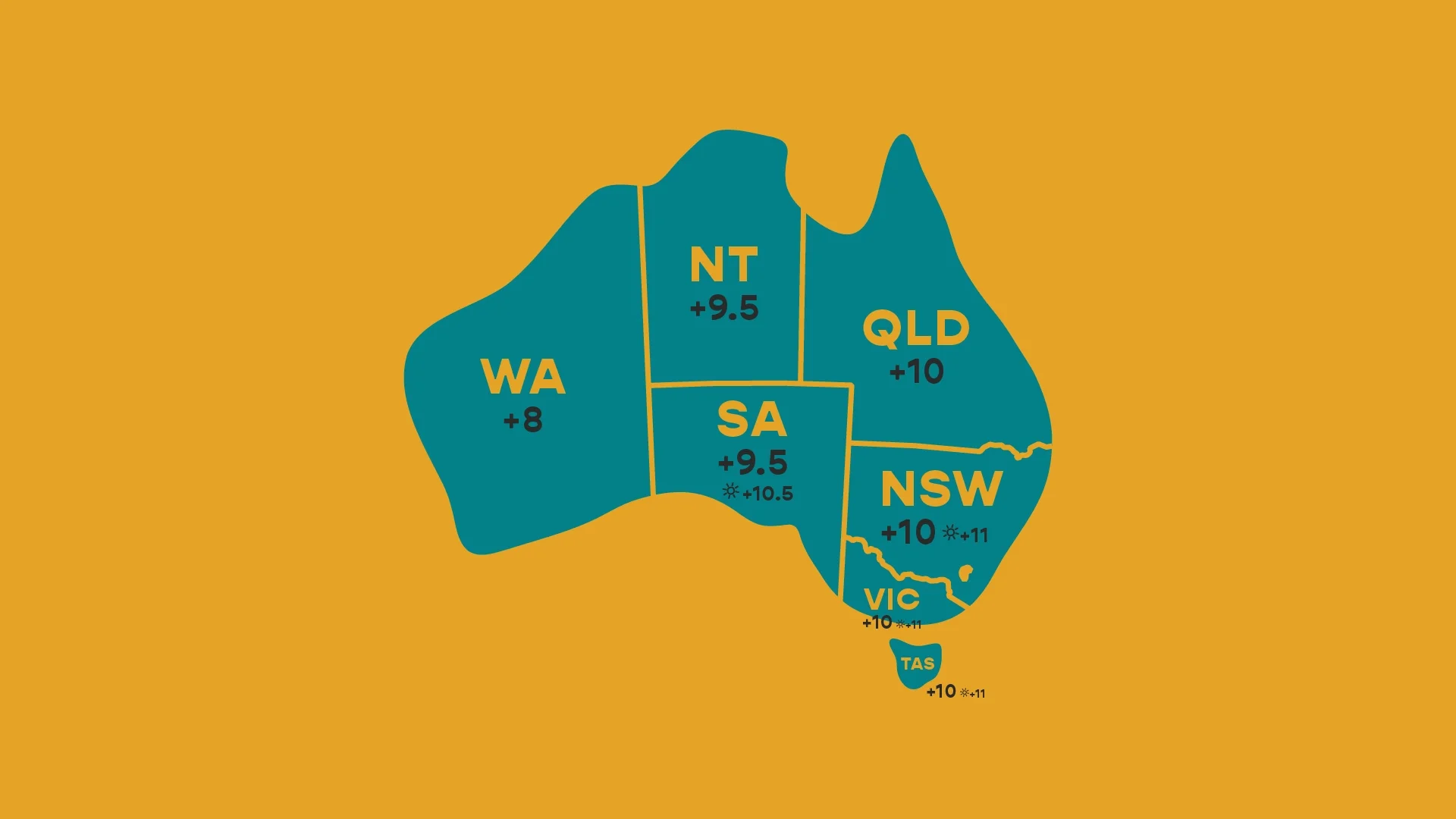
Australia has three official standard time zones.
AWST - UTC* +8 - Australian Western Standard Time
Western Australia is a vast state and whether you’re in Perth in the south or the remote Kimberley in the north, it’s all the same time, and it stays that way all year round.
ACST - UTC +9:30- Australian Central Standard Time
South Australia and the Northern Territory sit right in the middle, of the country. They’re also one of the few places in the world that uses a 30-minute time zone instead of a whole hour.
AEST - UTC +10- Australian Eastern Standard Time
Queensland, New South Wales, Victoria, Tasmania and the Australian Capital Territory all begin the year on Australia’s eastern time.
So far, so simple. Then daylight saving arrives…
Daylight saving changes everything
Every year, on the first Sunday in October, parts of Australia move their clocks forward by one hour. This continues until the first Sunday in April.
The states and territories that observe daylight saving are:
New South Wales
Victoria
Tasmania
South Australia
Australian Capital Territory
During this period:
AEST becomes AEDT - UTC +11
ACST becomes ACDT - UTC +10:30
Meanwhile…
Queensland doesn’t change.
Western Australia doesn’t change.
Northern Territory doesn’t change.
Suddenly Australia doesn’t have three time zones anymore…it has five!
No worries… unless you’re trying to organise a Zoom meeting.
Why doesn’t everyone use daylight daving?
Queensland, Western Australia and the Northern Territory don’t use daylight saving because the benefits are seen as minimal in their climates, where daylight hours don’t shift as dramatically through summer. It’s also been repeatedly rejected in public votes in some states, with many people preferring to avoid the disruption of changing clocks twice a year and the confusion it creates between regions.
Australia’s time zone quirks
As if five time zones weren’t enough, Australia has collected a few bonus oddities.
Broken Hill lives on South Australian time
Although Broken Hill is located in New South Wales, it follows South Australia’s time instead of the rest of NSW.
If you’re driving across the outback, your watch might suddenly change without leaving the state.
Lord Howe Island splits the difference
Lord Howe Island is different again. During winter it sits at UTC +10:30.
In summer it moves forward by 30 minutes, not a full hour, ending up on UTC +11.
The tiny 45-minute time zone
Near the Western Australia–South Australia border the towns of Eucla, Cocklebiddy, Madura, Mundrabilla and nearby communities unofficially use UTC +8:45.
That’s right. A 45-minute time zone. It’s not officially recognised, but locals have been using it for decades because it better suits life in the region.
No worries… eventually
Australia’s time zones might seem confusing at first, but they’re all part of the country’s charm.
Three standard time zones become five in summer, one town follows another state’s clock, one island moves by only 30 minutes, another region uses an unofficial 45-minute time zone, and one train even invented its own.
Next time an Aussie says, “Give us a call this arvo,” you might just want to ask…“Which arvo?”
*UTC - Coordinated Universal Time - Is the global “reference time” used around the world to keep clocks consistent. Starting from 0° longitude at Greenwich, it is the starting point that all other time zones are based on.
Still tangled in Australia’s time zones? You’re not alone.
If you enjoyed this guide and want to understand Aussie English, culture, and all the little quirks that make Australia… well, Australia, join theG’Day Galah Aussie Learning program.
From slang that changes state-to-state, to cultural context you won’t pick up in textbooks,G’DayGalah helps you speak and understand real Australian English in a fun, simple way.
Start learning today with the G'Day Galah Aussie Learning program and turn “wait… what did they just say?” into “no worries, I’ve got this.”